
Green Loans & Sustainability Premiums — How Energy-Efficient Homes Are Creating the Next Real Estate Revolution in India (2025–2030)
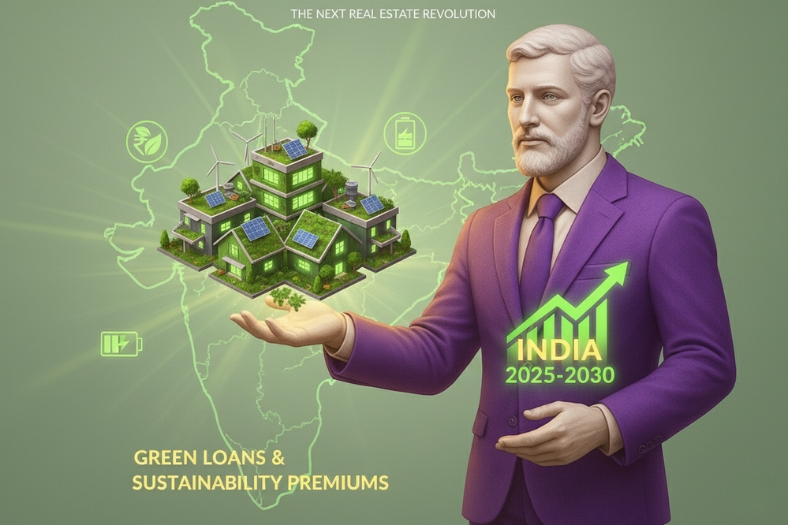
Sustainability is no longer optional. India’s Green Home boom is creating the next trillion-rupee opportunity in real estate — here’s how developers, investors, and agents can lead this transformation.
When Real Estate Turned Green, Profit Turned Gold
A decade ago, “eco-friendly housing” was dismissed as a marketing trick.
But the narrative has flipped — and this time, it’s financially irreversible.
From RBI’s Green Finance Framework to SBI’s Green Home Loans, and IGBC’s sustainable certifications, India’s real estate ecosystem is shifting from luxury-driven to eco-driven.
Developers who build green are selling faster.
Agents who talk sustainability are closing smarter.
And investors who understand green finance are earning higher returns.
Welcome to the Sustainability Premium Era — where compliance, climate, and credibility merge into one unstoppable growth wave.
What Exactly Are “Green Loans”?
Green loans are home financing products that reward eco-conscious construction.
In simple words — if your project saves energy, conserves water, and uses sustainable materials, banks will offer cheaper loans and buyers will get extra benefits.
Key enablers:
- RBI Green Finance Framework (2024) — official definition of green lending in India.
- IGBC & GRIHA Certifications — measure your project’s environmental performance.
- SEBI ESG Norms (2025) — make sustainability data mandatory for developers.
Banks like SBI, HDFC, and Axis Bank now offer interest rate reductions of up to 0.5%, with flexible tenures and faster approvals for certified projects.
This means going green now pays back — literally.
The Rise of the “Sustainability Premium”
Between 2022 and 2025, Deepmenia’s Real Estate Intelligence Cell recorded a 9–12% price premium for certified green homes across India’s top 10 cities.
Buyers are no longer asking for Italian marble; they’re asking for solar rooftops, rainwater systems, and better air quality.
And the data proves it:
- Green-certified homes reduce electricity bills by 25–35%.
- Water consumption drops by 20–25% through recycling systems.
- Maintenance costs decline by up to 20%, thanks to durable, sustainable materials.
- Resale value increases by 8–12% compared to traditional projects.
Deepmenia View:
“Luxury used to be about how your home looked.
Now it’s about how your home performs — sustainably, efficiently, responsibly.”
Policy & Regulation: Why India Is Going All-In on Green
RBI’s Green Taxonomy (2024)
The Reserve Bank’s framework encourages banks to prioritize low-carbon housing loans and mandates quarterly disclosures of green-lending volumes.
ECBC 2024 (Energy Conservation Building Code)
Residential buildings above 500 sq. meters must now integrate solar panels, LED infrastructure, and energy simulation compliance.
PMAY Urban Phase III (2025)
Now includes a “Sustainable Home” category — buyers of certified eco-homes can receive extra subsidies under central housing schemes.
State Incentives
Cities like Lucknow, Surat, and Pune now offer property tax rebates (5–10%) and fast-track NOCs for green-certified developments.
Developers’ New Strategy — Profit from Purpose
Leading developers are rewriting their blueprints.
Design Smart
Firms like Godrej Properties, Tata Housing, and Mahindra Lifespaces have reduced average power consumption by 35–40% using passive cooling and solar grids.
Finance Smart
The small cost of green certification (~3–5% of total project cost) pays back within 3 years through faster sales and higher brand trust.
Market Smart
Instead of “premium housing,” developers now promote “climate-resilient housing” — a language that connects emotionally and financially.
Investor Magnet — ESG Capital Flows Are Changing Direction
Institutional investors, REITs, and green funds are now looking for ESG-compliant projects.
Between 2023 and 2025, over ₹18,000 crore was invested in sustainable housing portfolios.
By 2030, that number could cross ₹90,000 crore, making green housing one of India’s fastest-growing asset categories.
Funds prefer:
- RERA-registered, ESG-disclosing developers.
- Certified projects (IGBC, GRIHA, EDGE).
- Measurable environmental ROI (energy savings, low-carbon materials).
💬 Deepmenia Analysis:
“In 2026, capital will chase compliance.
The projects that can prove sustainability will automatically attract global investors.”
Homebuyers 2.0 — The Conscious Consumer
The modern buyer, especially in Tier-1 and Tier-2 cities, sees sustainability as security.
According to Deepmenia’s 2025 survey:
- 73% of millennial buyers prefer eco-certified homes.
- 61% of NRIs say green credentials influence purchase decisions.
- 54% of women buyers prioritize air quality and resource efficiency over aesthetics.
In other words, green homes are no longer elite dreams — they’re middle-class aspirations.
Barriers to Scale — and Why They’ll Disappear Soon
- Cost Myth: Developers fear extra cost, but certification adds less than 5%.
- Awareness Gap: Only 25% of real estate agents understand green finance.
- Greenwashing: Some projects falsely claim “eco features” — this damages trust.
- Fragmented Policy: States vary in incentives; national standardization still needed.
💬 Deepmenia Insight:
“The only expensive thing about sustainability is ignorance.”
Outlook 2025 → 2030 — India’s Green Real Estate Explosion
India is standing at the threshold of a green construction boom.
By the end of this decade, Deepmenia Research forecasts that:
The number of certified green homes will surge from 3.5 lakh in 2025 to over 21 lakh by 2030 — a sixfold expansion.
Green loan disbursals are projected to jump from ₹18,000 crore to ₹90,000 crore, as major banks reclassify eco-housing as a priority-lending segment.
Buyer awareness is set to double, from 34% in 2025 to more than 70% by 2030, fueled by digital campaigns and sustainable branding.
Overall, the market value of India’s green housing sector will exceed ₹1.1 lakh crore,
making sustainability not just an environmental choice — but an investment strategy.
Deepmenia Forecast Summary (2025):
“Green real estate will no longer be the alternative — it will be the standard.
Every non-sustainable project will lose resale value and buyer trust.”
The Deepmenia Edge — Turning Awareness into Authority
At Deepmenia Business Academy, we’re preparing India’s next generation of real-estate consultants for this transformation.
Our “Green Real Estate Masterclass” helps you:
- Decode ESG, Green Loans & RERA Environmental Compliances.
- Sell sustainability with financial logic.
- Identify high-yield eco-projects before market saturation.
- Build your brand as a “Certified Green Advisor.”
Deepmenia Philosophy:
“The future of real estate belongs to those who sell solutions — not square feet.”
What Developers, Agents & Investors Should Do Next
For Developers:
- Integrate green design from concept stage.
- Partner with certification bodies early.
- Leverage tax rebates and green loan schemes.
For Agents:
- Learn green-finance terminology and certification benefits.
- Highlight “operational savings” instead of only property size.
- Use data-backed sustainability in your sales pitch.
- For Investors:
- Focus on verified ESG projects with measurable sustainability data.
- Target cities with strong municipal incentives (Lucknow, Pune, Surat).
Conclusion — Sustainability Is the New Monopoly
Real estate in 2030 won’t just be about towers, layouts, or location.
It’ll be about trust, compliance, and responsibility.
Green isn’t the future anymore — it’s the filter through which the future will be built.
And those who understand it now will dominate the next decade.
Deepmenia Business Academy | 90 Days Career Set | 10X Sales Growth Guaranteed










© 2025 Deepmenia. All Right Reserved.